It is not uncommon to encounter LC–MS systems that appear to be performing within specification, yet produce inconsistent or irreproducible quantitative results. In one case, a laboratory investigating low-level analytes in environmental samples reported stable retention times, acceptable peak shapes, and internal standard recovery within tolerance, but persistent signal suppression that varied unpredictably between runs. The issue was initially attributed to method instability or instrument performance. Subsequent investigation identified a combination of matrix carryover, insufficient sample cleanup, and gradual ion source contamination as the underlying cause.
Situations such as this are frequently observed in laboratory environments where instrumentation is operating correctly, but supporting workflows and physical conditions are not sufficiently controlled. Through working with laboratories on instrument selection and implementation, these patterns emerge consistently. The following discussion focuses on the dominant physical sources of error in LC–MS workflows and the mechanisms by which they affect data quality.
Liquid chromatography–mass spectrometry (LC–MS) is inherently sensitive to matrix effects due to the nature of ionisation, particularly in electrospray ionisation (ESI). Co-eluting compounds compete for charge within droplets, altering ionisation efficiency and producing either suppression or enhancement of analyte signal. Non-volatile salts, endogenous matrix components, and residual detergents are common contributors. These effects are highly variable and compound-specific, and are not always evident from chromatographic separation alone (King et al., 2000; Bonfiglio et al., 1999).
Sample preparation is therefore a primary control point for reducing variability. Inadequate cleanup allows matrix components to reach the ion source, increasing both short-term variability and long-term contamination. Techniques such as solid-phase extraction, protein precipitation, and filtration serve not only to isolate analytes but to stabilise ionisation conditions. Variability in execution of these steps, particularly in manual workflows, introduces inconsistency in matrix composition between samples. This directly affects quantitative reproducibility. Standardised or automated preparation reduces this variability and improves inter-batch consistency.
Contamination within the LC–MS system itself is a cumulative and often under-recognised issue. Ion source components, including capillaries and sampling cones, gradually accumulate non-volatile residues. These deposits alter ion transmission efficiency, increase chemical background, and contribute to carryover. Over time, this results in drift in response factors and reduced sensitivity. Because this process is gradual, it is often misinterpreted as method instability rather than physical degradation of the system. Regular cleaning and maintenance of ion source components are required to maintain consistent performance.
Carryover introduces an additional layer of error, particularly in trace-level analysis. Residual analytes can persist in autosamplers, injection pathways, and column surfaces, leading to false positives or elevated baselines. This is influenced not only by wash protocols but by the physical design of the system, including dead volume and surface interactions. Autosamplers with effective needle wash systems and low-retention flow paths reduce the likelihood of carryover, particularly for compounds with high surface affinity.
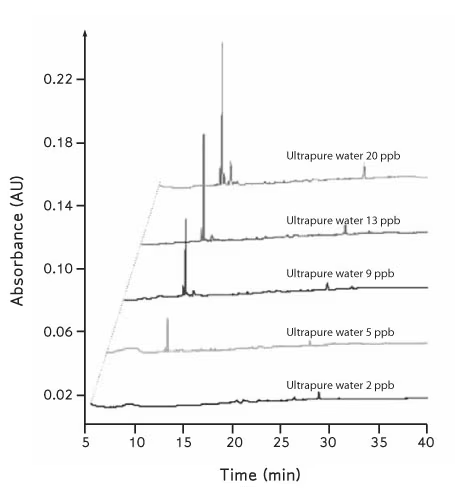
Mobile phase composition and solvent quality also contribute to system stability. Trace contaminants, including plasticisers and degradation products, can accumulate in the ion source and contribute to background signal. Non-volatile impurities exacerbate ion suppression and reduce sensitivity. Consistent use of high-purity solvents, along with appropriate filtration and handling, reduces these effects. Importantly, variability in solvent preparation between batches can introduce additional inconsistency in ionisation conditions.
Fluidic stability within the LC system influences both chromatographic separation and downstream ionisation. Variations in flow rate, gradient formation, or pump performance alter retention behaviour and co-elution patterns, indirectly affecting ionisation efficiency. Worn pump seals, minor leaks, or pulsation can introduce subtle but significant variability. High-quality LC systems with stable flow delivery and accurate gradient control reduce these sources of error.
Temperature control is another contributing factor. Variations in column temperature affect solvent viscosity and analyte retention, while fluctuations in autosampler temperature can influence sample stability. These changes alter both chromatographic behaviour and ionisation conditions. Maintaining stable and controlled temperature environments improves reproducibility across runs.
While internal standards are commonly used to correct for variability, they do not fully compensate for all sources of error. Matrix effects can vary between samples in ways that are not fully captured by a single internal standard, particularly in complex matrices (Matuszewski et al., 2003). As a result, reliance on internal standards without addressing upstream variability can lead to persistent inaccuracies.
Instrument-level metrics such as signal intensity, peak shape, and mass accuracy provide useful indicators of system performance but do not capture underlying sources of bias. A system may meet performance criteria while still producing quantitatively inaccurate results due to unresolved matrix effects or contamination. This distinction is critical in workflows requiring high analytical confidence.
In practice, reducing error in LC–MS workflows requires control of both chemical and physical variables. Effective sample cleanup, consistent solvent quality, stable fluidics, and routine maintenance of ion source components collectively improve reproducibility. Equipment that supports these requirements—through precise fluid handling, low-retention flow paths, and accessible maintenance—plays a central role in maintaining system performance.
In working across different laboratory environments, a consistent observation is that LC–MS systems rarely fail in isolation. Variability is typically introduced through the interaction of sample preparation, system cleanliness, and physical handling. Addressing these factors at the workflow level, rather than focusing solely on the mass analyser, is central to improving data reliability.